


Daughter-in-law of Flying Tiger who taught in Fujian province sees lessons in ordinary people always finding ways to understand one another
When Elyn MacInnis first moved to Nanjing in the late 1980s, she was greeted by a wholly unexpected connection.
Local elderly residents would look at the American newcomer, pause and tell her she resembled Minnie Vautrin: a middle-aged woman with round glasses and centre-parted hair often pinned up.
MacInnis, who goes by the Chinese name Mu Yanling, knew the name only vaguely then.
Vautrin was an American missionary who led Jinling Women's College during the Nanking massacre, in the city now called Nanjing. Vautrin sheltered and saved thousands of Chinese women and children when Japanese troops captured the eastern Chinese city.
For six weeks from December 13, 1937, Japanese troops stormed the city, killing, raping and looting. Historians' estimates of the fatalities vary widely, ranging from the tens of thousands to as high as 300,000. Saturday marks the 88th anniversary of the Nanking massacre.

Elyn MacInnis stands before a statue of Minnie Vautrin, who was an American missionary during the Nanking massacre of 1937. Photo: Handout
Later, standing before Vautrin's formidable bronze statue at the memorial hall dedicated to the victims of the Nanking massacre in Nanjing, MacInnis felt profoundly humbled.
"I thought, yeah, we do look a little bit alike," the 74-year-old recalled. "It's a big honour."
That moment of personal, almost eerie, linkage to a protector in China's darkest hour was her first, deeply human entry into a city's traumatic history. Ultimately, MacInnis would choose to engage with Nanjing's past not as a spectator but as a steward.
Her family's bond with China over three generations is remembered as a testimony of Sino-U.S. friendship forged since the second world war.
And her stewardship was on full display this year at the same Nanjing memorial, as China marked the 80th anniversary of the end of World War II and the global victory against fascism.
In September, MacInnis donated to the museum a set of historical artefacts collected from American families, including magazines featuring the Flying Tigers and a crumbling cream-coloured Japanese propaganda leaflet from 1937 meant to demoralise Chinese resistance. Previously, she donated war photos taken by foreigners who were then in Nanjing.
"All of these things have stories about courage or kindness or cooperation," MacInnis said. "When we have the shared memories, we can remember that the trust between our countries was built a long time ago through real people and real things that happened."
This belief is the thread weaving together the remarkable tapestry of MacInnis' life and work. Her journey bridges the shared sacrifice of World War II to the people-to-people exchanges of today, embodied in bilateral initiatives like the "Bond with Kuliang" and the recent Kuliang Forum in New York.
The foundation for this unusual connection was established by her father-in-law, Donald MacInnis, whose Chinese name was Mu Airen.
In 1940, the 20-year-old American arrived in China's southeastern Fujian province to teach English. When Japanese bombings forced his school to evacuate to the countryside, he stayed with his students, enduring hardship and forming lifelong bonds.
He later joined the "Flying Tigers", serving as a "coast watcher" in the city of Xiamen, radioing coordinates of Japanese ships and narrowly escaping capture.
The Flying Tigers, officially called the American Volunteer Group, were a team of pilots hired to help China fight against the Japanese invasion. They battled the more advanced Japanese air force over China and Southeast Asia from late 1941 until the summer of 1942. After that, many of the pilots officially became part of the U.S. Air Force to keep fighting.
After the war ended in August 1945, Donald MacInnis returned to the United States but later came back to China to teach again. His second son, Peter, was born in Fujian's capital city, Fuzhou, and would become Elyn's husband.
The couple met as graduate students, married and had two daughters. In 1988, they moved to Nanjing and then spent the next three decades in China across different cities.
In 2015, Peter and Elyn fulfilled Donald's final wish to scatter part of his ashes in the Min River in Fujian. That pivotal trip ignited Elyn MacInnis' defining mission.
In the mountain retreat of Kuliang, where diplomats, educators, doctors and their families from the foreign community lived alongside Chinese neighbours in the late 1800s and early 1900s, MacInnis discovered a history slipping into oblivion.
Lacking complete records, she embarked on a detective's quest. In 2016, she formalised this network as the "Friends of Kuliang", which has united about 50 descendants of Kuliang's American families.
Teaming up with Lin Yinan, a professor at East China University of Science and Technology in Shanghai, and with help from Guo Qing, a local historian, they formed the Kuliang Research Team.
Over the years, the group has collected more than 2,000 old photos, and Lin's students created an AI application to identify people in the old photographs, helping to make the history clearer.

Pilots of the American Volunteer Group, famously known as the "Flying Tigers". Source: Handout
Thousands of records from former residents were also collected from archives across the U.S., including diaries, books, letters, meeting notes and more.
Among the stories they collected were those of doctors turning summer homes into clinics and teachers tutoring mountain children during holidays.
In one instance, an American helped bring peace by mediating between the government and bandits, risking his son's safety to earn their trust.
In another, a member of the American Flying Tigers was badly wounded in a forest while investigating a downed Japanese plane. A bomb had exploded in his hands and face, blinding him temporarily and costing him parts of five fingers.
His Chinese childhood friend, who was then a medical student, heard about his injury and travelled many miles to perform emergency surgery in primitive conditions.
To MacInnis, the stories showed that ordinary people always found ways to understand and support one another, even in tough times.
Preserving objects and stories from the past was like giving "a gift to young people", showing them that friendship is not merely an idea, she said.
"Friendship is something that generations lived through and protected and passed on. When we talk about those feelings, what happened in those days, we can think about the challenges for today."
What began as historical recovery has blossomed into a forward-looking engine, manifested in the "Kuliang spirit", which MacInnis defined as "peace, friendship, understanding, respect and love" that now animate contemporary exchanges.
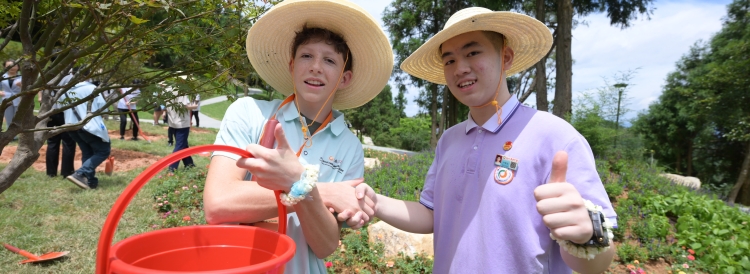
It is the soul of programmes like the "Bond with Kuliang" summer youth gathering that brings together students from both sides for cultural immersion in Fujian.
The experience allows young Americans to experience China first-hand, breaking down stereotypes and building friendships.
In July, Peng Liyuan, wife of Chinese President Xi Jinping, attended the annual event, praising the deep bond between the two countries and encouraging young people to build lasting friendships.
"Kuliang mountain itself is very inspiring," MacInnis said of the programme. "If our ancestors could come back, they would be very, very happy to see all the good things that are happening through Kuliang."
"It's not a political thing," she continued. "It's a human commitment. What Kuliang shows is ordinary people will continue to choose connection when they get together and spend time together."
MacInnis' efforts also align with broader governmental efforts to nurture grass-roots ties, including China's initiative to invite 50,000 young Americans to China over a five-year period, as announced by Xi in 2023.
Amid a difficult period in Sino-U.S. relations, Beijing has been turning to stories like those of the Flying Tigers and other past collaborations as a way to bolster current ties, focusing on people-to-people exchanges, which have slowed since the coronavirus pandemic.
Last month, Xie Feng, China's ambassador to the U.S., delivered a speech in New York at the 2025 Kuliang Forum, which was inspired by MacInnis' work. The event drew more than 150 attendees, including descendants of the Flying Tigers and Kuliang families.
Xie said that Xi had personally promoted the story of Kuliang, noting the Chinese leader sent a congratulatory message to the forum in 2023.
The ambassador believed the story symbolised deep friendship and understanding between China and the U.S., despite their different histories and political systems.
"It shows that both nations can overlook differences and build new chapters of friendship and cooperation," Xie added.
For her part, MacInnis is focusing on bringing out new stories that she hopes can encourage, inspire and "give the young people a new feeling for what they can do."
One quiet conversation in Nanjing decades ago has always stayed with her.
In the 1990s, at a local orchestra, an elderly doorman confided that during the Nanking massacre of 1937, he and his brother were the only ones in their family to escape. They did so by running for their lives, he explained, but all the others were killed.
MacInnis, knowing Japanese tour groups often visited Nanjing, asked how he felt about welcoming them.
"These people are not those people, not militarists. These people are respectful of Chinese culture," she recalled him saying. "He said you really have to let go of that to move into the 21st century … His heart was probably one of the biggest hearts I ever met."
To MacInnis, remembering means safeguarding a fragile leaflet as shared evidence of history, and building the future means guiding young people up the paths of Kuliang to forge their own bonds. It is in this delicate, powerful balance that ordinary people, as she has proved, can chart an extraordinary path forward.
She summed up her conviction by invoking a sentiment voiced by Fuzhou-born writer Bing Xin: people should forget what needs to be forgotten and remember what needs to be remembered.


